.png?width=150&height=48&name=3devo%20-%20Blue%20and%20Dark%20logo%20(1).png "3devo - Blue and Dark logo (1)")
Share this
by 3devo on Mar 30, 2026, 4:29:48 PM
Developing advanced materials for industrial applications is rarely a straight path.
Validation often depends on multiple external steps, from filament supply to repeated testing cycles, while material development and application testing remain somewhat disconnected. As a result, learning can be slow, and it can be difficult to assess how a material will behave in a real use case before moving further down the line.
In many cases, the challenge is not only the material itself, but being able to evaluate it early enough in a real application.
Where The Friction Actually Sits
Material development and application testing often follow separate tracks.
On one side, materials are formulated and tested in controlled conditions. On the other, application requirements, geometry, performance and perception, are only evaluated later in the process.
This gap can create a number of practical challenges:
- reliance on external filament suppliers for early testing
- delays between iterations
- limited ability to demonstrate real parts early
- uncertainty when moving toward tooling or production
While each of these steps is necessary, the distance between them can slow down decision-making and make validation less efficient than it could be.
Bringing Part of The Process In-House
A shift we increasingly see is bringing part of the validation workflow closer to the development stage.
By enabling in-house filament production and using filament extrusion systems to convert material pellets into filament, teams can move more quickly from material formulation to real part evaluation.
This creates a more connected workflow:
material → filament → printed part → evaluation
Instead of waiting for external steps, teams can iterate internally and test materials in application-like conditions much earlier.
What This Enables in Practice
Bringing this part of the workflow in-house does not replace traditional processes, but it changes when key decisions can be made.
In practice, it allows teams to:
- evaluate materials in application-relevant geometries earlier
- reduce dependency on external suppliers during early validation
- iterate faster between material formulation and application testing
- support internal discussions with tangible parts rather than assumptions
- make more informed decisions before committing to tooling
This becomes particularly relevant in industrial contexts, where the cost and time associated with late-stage changes can be significant.
From Material to Application: A Practical Example
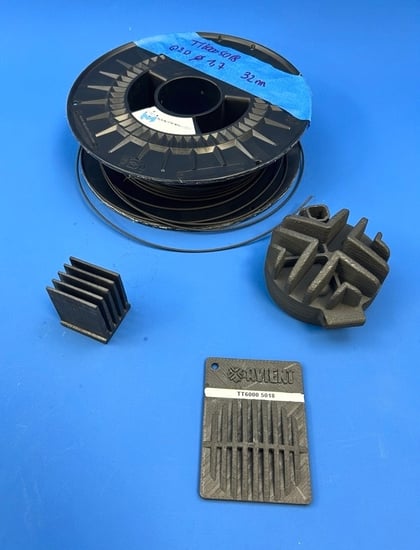
In collaboration with Avient, this approach was applied across different types of materials and use cases.
In one case, Gravi-Tech™ Density-Modified Formulations were used to develop a premium component where weight and perceived quality were key factors. By producing filament internally and creating early prototypes, the team was able to evaluate how the material behaved as a real product, not just in isolation.
In another case, Therma-Tech™ Thermally Conductive Formulations were tested through a heat-dissipating component. This allowed the team to explore geometry, form, and functional behavior in parallel, supporting earlier learning before moving further toward production.
In both cases, the focus was not only on material properties, but on how those materials perform in real applications.
Bridging Toward Production
This approach also connects more directly to downstream manufacturing processes.
In one example, a 3D-printed mold was produced and used for injection molding to assess a heat sink component. This made it possible to evaluate performance, weight reduction, and manufacturability before committing to full-scale tooling.
Rather than treating prototyping and production as separate phases, this creates a more continuous path from early validation to industrial manufacturing.
A Shift in How Validation Happens
This does not replace existing development workflows, but it helps bring validation closer to the application stage, where decisions actually take shape.
By reducing dependency on external steps and enabling earlier, more tangible testing, teams can move faster, learn sooner, and make decisions with greater confidence.
As materials and applications continue to evolve, this closer connection between development and real-world use is becoming increasingly important.
If you’re working on new materials or applications, it’s worth considering how early you can bring validation into your process, and what that might change in practice.
You can explore the full Avient case study here.