.png?width=150&height=48&name=3devo%20-%20Blue%20and%20Dark%20logo%20(1).png "3devo - Blue and Dark logo (1)")
Share this
by 3devo on Mar 18, 2026, 1:45:58 PM
Multi Jet Fusion (MJF) has become a mainstream industrial process. But like every production method, it comes with trade-offs.
One of them is surplus powder.
While part of the material can be reused, a percentage inevitably becomes unusable over time due to thermal and environmental exposure. In most cases, this ends up as waste.
For us, the question was not just how to recycle it, but whether it can work in a reliable and commercially viable way.
Starting From Validation
Over the past months, we’ve been working on converting PA12 powder waste into usable filament through our internal extrusion setup in the Netherlands.
The result is rPA12, now commercially available in collaboration with Filamentive.
But internally, this project is less about launching a new material and more about validating a process.
Recycling in additive manufacturing only becomes meaningful when it works consistently, under controlled conditions, and delivers output that can actually be used in real applications.
What The Workflow Looks Like
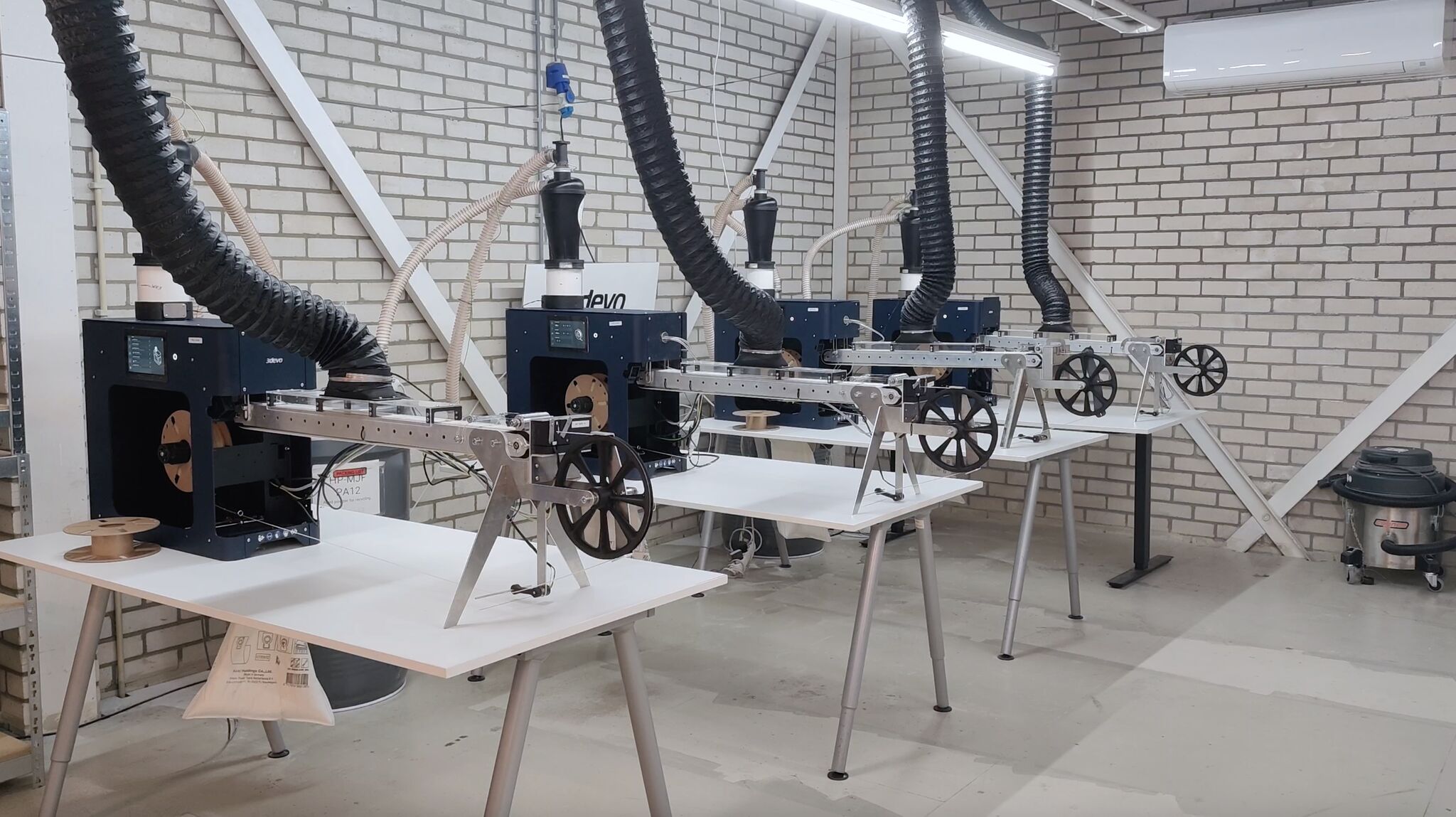 At a high level, the process follows a controlled extrusion workflow:
- Powder is transferred directly from storage into the system
- It is fed through a dedicated hopper and melted across multiple heating zones
- The material is extruded, cooled and formed into filament
- Diameter is continuously measured and adjusted through a closed-loop system
- The filament is automatically spooled, with full data logging for traceability
The goal is to reach a point where the process is stable, repeatable and measurable.
Moving Beyond The Lab
The internal setup acts as a validation environment, where material workflows are continuously tested and refined.
Now, we’re extending that into pilot setups with selected partners.
The goal is to understand how these workflows perform outside controlled conditions, in real operating environments, with real constraints.
Alongside MJF recycling, similar approaches are being explored across different use cases, from SLS powder streams to end-use part processing and small-scale production setups.
Why This Matters
For many teams, material validation still depends on external suppliers, multiple iterations, and a fragmented workflow between development and application.
Bringing part of that process in-house changes the dynamic, both in terms of sustainability and operations.
Less dependency.
Faster iteration.
More control over outcomes.
What comes next
The long-term direction is to enable teams to process and reuse materials closer to where production happens, when it makes sense operationally and financially.
The rPA12 filament is one example of what that can look like.
But the bigger story is the workflow behind it, and how that workflow can be applied across different materials, setups and use cases.
If you’re working with MJF or exploring in-house material processing, feel free to reach out.